This is a poem I wrote last year around this time for a project called “Say Their Names.” This was a collaboration between photographer Donn Young, writer and historian Mike Ogle, and County Commissioner Renee Price. You can Google it if you want to find out more about it.
This was one of my contributions to the project. The poem was me thinking about the MOVE bombing of 1985 on Osage Avenue in Philadelphia; it also includes some thoughts on the revelation that the remains of those killed in the fire were at the University of Pennsylvania and how they studied and disposed of those remains last year.
Tomorrow September 23, 2021, would have been John William Coltrane’s 95 birthday. This year, after 5 years of living in Trane’s home state of NC for almost 5 years now, I finally got to celebrate his commemorate his birthday in a way that I think got me thinking again about what his life and music have meant to me.
My friend and neighbor, Jazz Incognito, (WXYC 89.3 FM Chapel Hill) has an amazing radio show that spend so much good music, invited me on his show to speak about John Coltrane, poetry, and what his work has meant to me. Not only was it a lot of fun, but I think it could be a step toward my own re-engagement with his work. Some time ago, I remember being discouraged from writing poems inspired by Jazz and Trane by some folks whose opinion I really took to heart, so I had stopped. Today, as a poet and writer, I have a little more confidence in my voice and more tools at my disposal, so perhaps I am better equipped to reflect and more fully say what I want to say about Trane’s life and music.
Here the interview I did with Jazz Incognito and a portion of the show. I encourage you to check out the whole show when it air and check out the amazing archive of shows on Jazz incognito, you won’t be sorry .
Here is one of my poems inspired by Trane and his experiences in Japan. Thanks to Kim Roberts for publishing this poem on Beltway back in 2007, it was (and still is) such a blessing to have my poems published there among writers and thinkers who love.
TRANE’S BLUES @ NAGASAKI
in a world where calls to prayer
are interrupted by the hot wail
of breaking bones and the rhythm
of blood spilling.
i have learned to question.
what is this way of seeing, viewing
the world through a ring of brass?
what is the sound that follows sight
whole notes blown
to be a force for good…
a drone calls me at the hour of God;
the sound is like that first hit.
the high that begins the search
more inward, than interstellar
i have found that the warm space
under sheets of sound
is my sanctuary, the calm center of a whirlwind
trapped in fire-shaped brass; every whole
note is a prison for all
the suffering I have ever seen.
I know you are looking at the title of this post and thinking, ” what happened to #1 & #2?” The answer is I am getting there…This is my attempt to show the process by which some pieces of writing or projects happen.
I am 3 weeks into The Studio Museum in Harlem’s Museum Education Practicum and I am having a ball. There are so many smart and accomplished people in this class, I am really happy to be a part of it and I hope that it spawns some opportunity for collaboration and future projects together.
Because of a project that I am currently working on, I started thinking about the people who are not in this class and who might benefit from hearing about what we are doing. So I decided to try to do some brain dumps or some kind of summary after my class.
Today the readings were all about the term “post-black.” I think it is almost impossible to talk about The Studio and not at least mention this term. The Week #3 readings were very interesting, they were the following: 1. “Is there a ‘post-black’ art?” by Cathy Byrd 2. Introduction to Freestyle by Thelma Golden 3. “The Multiplicity of Multiplicities–Post-Black Art and its Intricacies” by Nana Adusei-Poku
I remember when i first heard this term amongst my poet and writing comrades we were like, “WTF is a post-black.” My first inclination is that is was another way to call Black artists the N-word and if not it would be used that way. The other thing that happened too is that i feel like there was a lot of backlash at the suggestion of a period “after” black. One of my mentors turn the whole discussion on its head and said, “Nah, the real discussion we should be having is is “post-whiteness.” After our last 4 years it is clear that we as a country and a world need to think about the reality that the construct of whiteness has wrought an continues to impact in our world and what kind of world is possible “post-whiteness.”
Some the important topics that came up in the small groups I was in were:
Commodification: All art is commodified, that is why they call it the “art market.” That said we discussed because Black artists represent such a segment of said market, establishing a term like “post-black” that could be (or be used as) a package marketing term to tell the “art market” that this artwork will not make you feel guilty, you can view without having to think about that old, pesky Race, or Racism, or Blackness.
Tensions: To be Black and creating is filled with tensions because black life at large is filled with tensions. Even Black artists that art not creating expressed “Black” work feel the pressure of being who they are in the world.
Process (& Material): In our discussions about the artists in the videos we were asked to watch (Senga Nengudi, Jack Whitten, and Kevin Beasley), it was so instructive to see the artists talk about a piece of work and walk us through its creation and the ideas and craft that go into the work.
Our instructor also asked us to consider the term post-black and more specifically how the term made us feel and how we thought the term functions/(ed).
There was much more but I think this captures the main elements….
Stay Tuned. I will fill you in on #1 & #2 later. See you next time…
I had the good fortune to be on a panel as part of the Mosaic Literary Conference a few weeks ago. Ron Kavanaugh has been a literary activist and warrior for the Black literary world for a long time. One of my first published writings was published in the pages of Mosaic Magazine, so it was an honor to be on this panel with such accomplished folks: Tai Allen (moderator), Janice Lowe, and Dimitry Leger.
With thanks to NC Poet Laureate Jaki Shelton Green and Timothy Crowley, I have a poem included in this cool anthology that just came out. So far, I only see it listed on Amazon, but you can ask your local bookstore to get it from Chapel Hill Press. For those who are local to Chapel Hill, check Epilogue and Fly Leaf.
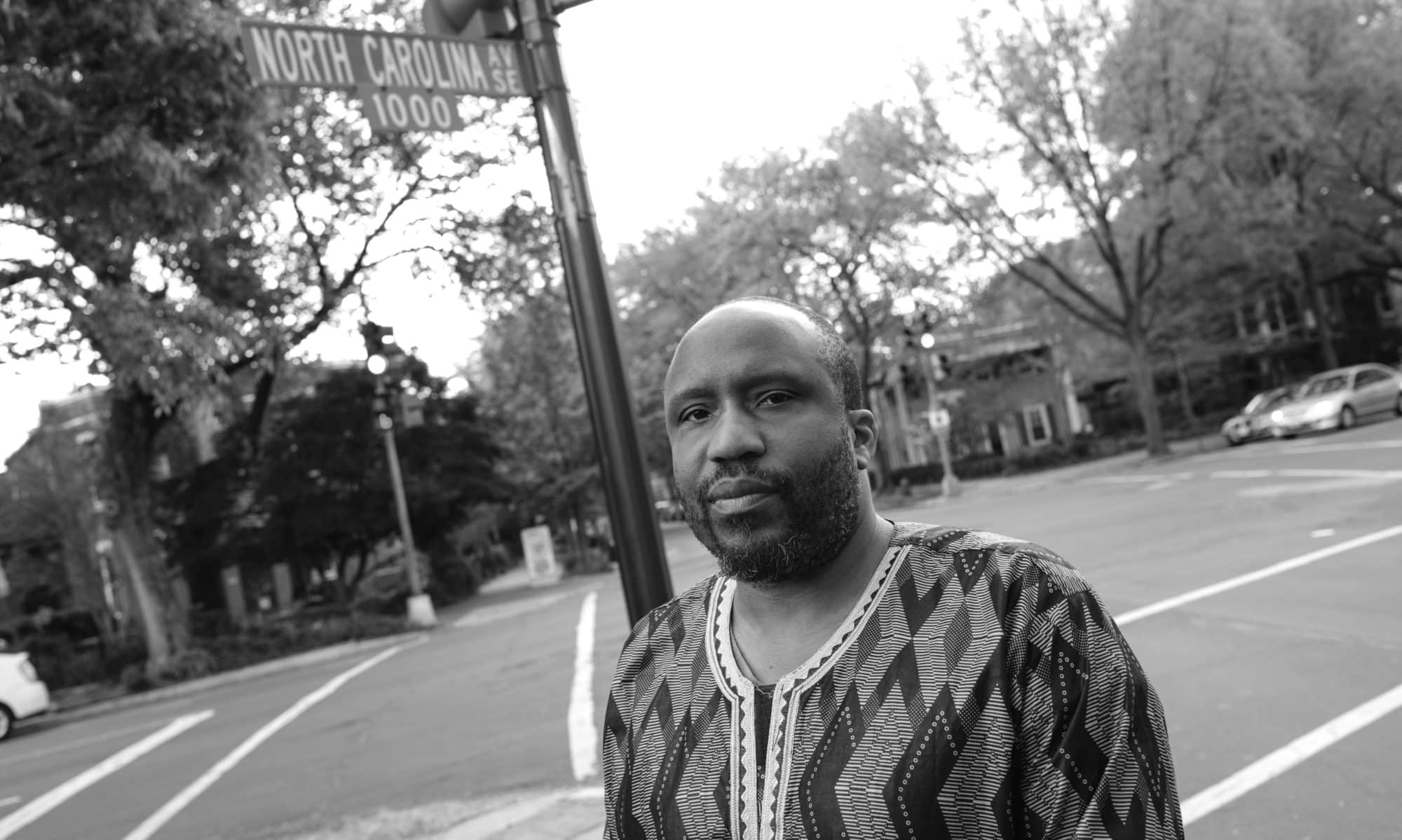
This a picture of me when we first moved to Bamako, Mali, and had just started blogging at one of my other sites BOOM For Real Bamako.
I know my website needs a little updating. I am getting to it, please bear with me. In the meantime check a few links of me reading or talking about my work
While it is an honor to have any organization support or feature your work, this reading in particular was a distinct honor to be a part of because of what this organization means to African American Poetry in particular, and American Letters in general.
This program is in support of the newly published Furious Flower anthology, Furious Flower: seeding the future of african american poetryedited by Dr. Joanne Gabbin and Lauren Alleyne. My presentation starts at 49:03, but you will miss a poetry blessing if you don’t listen to the who thing.
This is a piece I did with the Sciences Po School of Journalism in Paris , France. Thank you to Pariesa Young for reaching out to me after finding my poem Currency.
The following link is a link to the business and economy program Marketplace, it airs on NPR. Thank you to Maria Hollenhorst for finding my poem Austerity on the Academy of American Poets website. I know some writers are used to a certain type of acclaim and recognition, but for me as a poet who does not have my own collection out in the world YET, it is an honor to have my poem on this website. It is hard to put in words.
Last but not least, is a reading I participated in with some other amazing writers to celebrate the publication of the Carolina African American Writers’ Collective’s new anthology All the Songs We Sing edited by Lenard D. Moore with an introduction by NC Poet Laureate Jaki Shelton Green. It was such an honor to not only be included in this anthology but also to be welcomed into the fellowship of the Carolina African American Writers’ Collective, so needless to say that my gratitude abounds. Thanks to Lenard D. Moore for welcoming me into the fold.
Join us for a celebration of the rich legacy of Black poetry as contributors to the third Furious Flower anthology, “Furious Flower: Seeding the Future of Black Poetry,” read from their work and share their thoughts on legacy as poetic practice. The event features poets F. Douglas Brown, Dominique Christina, Toi Derricotte, Alexis Pauline Gumbs, Terrance Hayes, DaMaris Hill, Tyehimba Jess, Fred Joiner, Nate Marshall, and Clint Smith, with a critical context by Meta DuEwa Jones, and remarks by Rita Dove, Parneshia Jones, and Joanne Gabbin. Register now and receive a discount code with your purchase of Furious Flower: Seeding the Future of African American Poetry
I have really been enjoying so much of the work coming out in Poetry Magazine; Don Share and his crew have done an amazing job in (re)making the magazine.
While I was reading this month’s issue I came across Nicole Sealey‘s poem And, even better was hearing her read it here. I was immediately reminded of Thomas Sayers Ellis’ poem, Or and how both of these poems use the conjunctions And & Or as sonic and meaning-making devices.
I am still trying to figure out everything going on in Sealey’s piece but it is such a nice and rich ride, but I don’t mind working my way through it.
People have all kinds of ideas and things to say about what poetry does and does not do. I hear people often quoting William Carlos Williams saying:
“It is difficult to get the news from poems yet men die miserably every day for lack of what is found there.”
I tend to disagree with the suggestion that you cannot get the news from poems, but I think that is conversation for another day.
Today I had the opportunity to use poetry in a manner that will empower people to do something for themselves and others. As part of Activate! IFC’s advocacy program I conducted a poetry workshop on writing poems of Self-Definition and Self-Determination. Activate! IFC serves populations experiencing homelessness, voter disenfranchisement and a range of equity centered issues. You can learn more about them here .
I had the privilege to listen to people telling their own stories and writing new ones that would be mantras for them to use as encouragement for themselves in dark times. I saw them offer encouragement to one another to share their stories and to advocate for themselves in their own words.
I had them writing short poems using the prompts “I am…” and “where I’m from…” that I got from Willie Perdomo. I was always so moved by Willie Perdomo‘s poems from Where a Nickel Costs a Dime because I the speakers in his poems sounded like people I knew.
I know that poems may not necessarily put a roof over some the workshop participants heads, but a poem could be the thing that moves them to advocate for themselves for more affordable housing or a livable wage, so I am thankful for that. If poetry can do that everyday I think poetry does a lot.