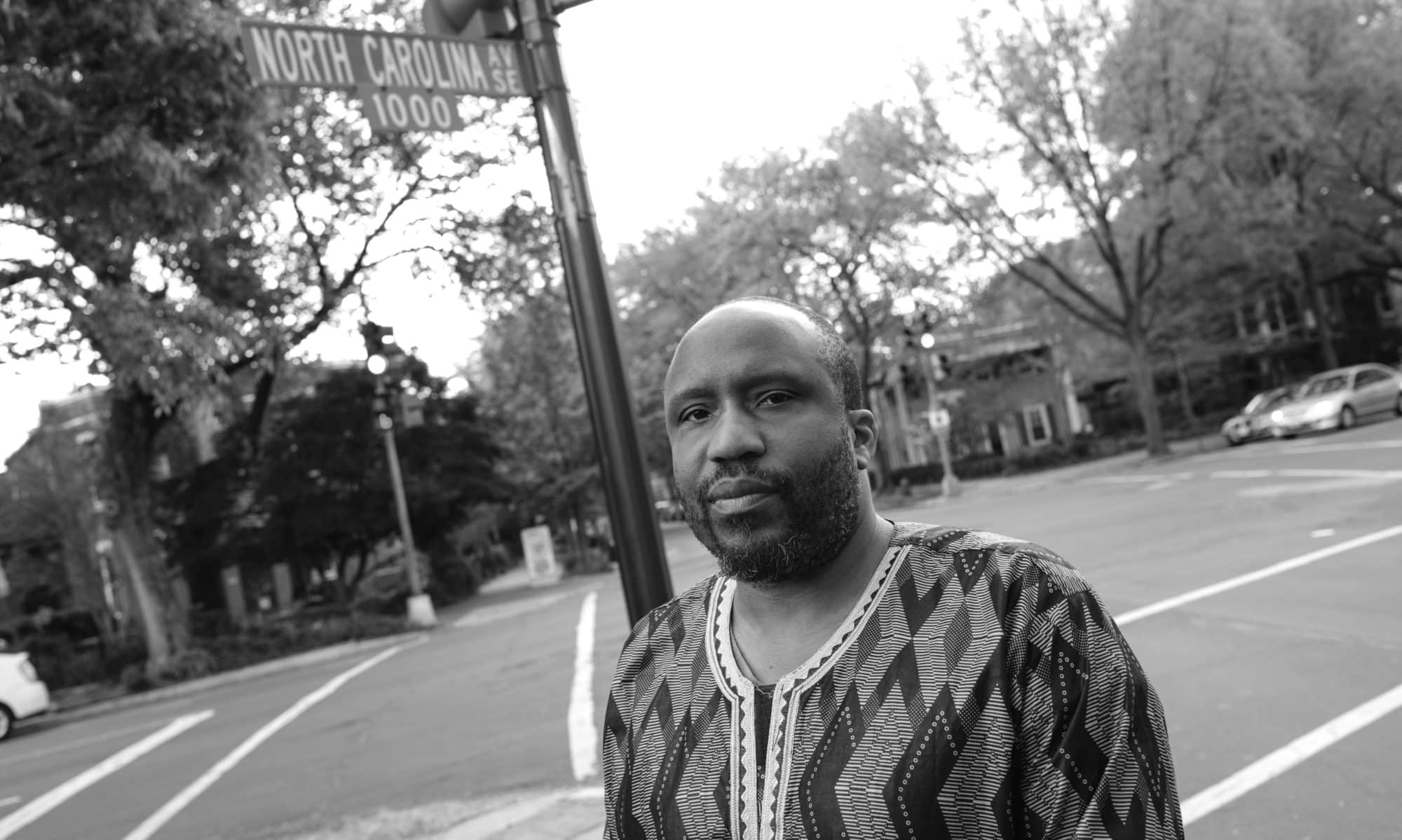
I have had the privilege of knowing Bro. Yao ( Hoke S. Glover III) for quite some time. I don’t really remember how long it has been, but I do remember the conversations we used to have at the Karibu Books that was in the Landover Mall. We did not learn that we were both poets until a bit later.
Today on Rattle’s website‘s, Bro. Yao’s poem “PUTTING THE NIGGERS TO REST“ is the poem of the day. After reading it, I immediately thought of The Roots song 75 Bars (Black Reconstruction) ( I also thought of DuBois’ Black Reconstruction in America, but that is a much longer discussion for another time), from their 2008 album Rising Down; on which Black Thought uses both Nigger(s) and Nigga(s) repeatedly in punctuating his lines.
Right of the top, in Yao’s poem, I do notice various types rhymes and sonic pleasures that Yao layers into the poem.
I am going to spend some time with these two pieces to look for similarities beyond the repetition of Nigger(s)/Nigga(s) and the strikingly similar distribution of the word throughout, but I couldn’t ignore both poets’ use of Nigger(s)/Nigga(s) , perhaps as a way of pointing to some other layered meaning …….
Other Links to check out:
Bro. Yao’s (Hoke S Glover III) new book, Inheritance
Me @ Studio Sidibe, The studio of renowned Malian photogrpaher, Malick Sidibe.
As usual, the end of the year puts me an introspective mood, which sends my mind all over the place. Very often I find myself thinking about the future, what the next move will be for me, my art and my family. But quite often before I dive into the future, I find myself thinking about the year that has passed, what I have lost, gained, learned or even what I am going through at the present moment.
As those thoughts pass through my mind, I am in a mood of gratitude in general , but also because of some recent good news…
A few months ago, one of my poems was accepted by The Editors (Mahogany L. Browne and Amanda Johnston) for the #blackpoetsspeakout issue of Pluck! Journal of Affrilachian Arts and Culture (click here & here for more info). Needless to say it is an honor to be a part of the sea of poetic voices speaking up for our people as we face the crisis of state sponsored and sanctioned violence, through police and law enforcement who are supposed to be serving and protecting. Because I am living abroad, it hard to watch and to hear about all the things going on and not to be present to be a part of protests or to help out in someway. But I also realize this is a global issue and that the work I am trying to do with empowering Malian (and other West African artists) is a part of that struggle too.
Because of the vision of the guest editors, that this issue of pluck! was intended to be used as “a personal amulet, a tool in the classroom and a hammer in the streets. Get it either way, but carry it forward.” Editor Amanda Johnston goes on to say “Because this work is for the people and these poems have work to do, pluck! issue 13 is now available for FREE online. Click here to read now.”
Here is how you can get a print copy for you or your institution:
Pluck! $15/copy mail to:
pluck!, 1215 POT
University of KY
Lexington KY 40506
$30/subscription for individuals
$100/sub for institutions and organizations
Secondly, I am grateful that Sarah Browning accepted a few of my poems for a forthcoming issue of the Delaware Poetry Review that will be out Spring of 2016.
And…
Last, but most definitely not least, I just found out a few days a ago that a small dialogue that I recorded with Kwame Dawes ( find him here & here) will be included in the final cut of Furious Flower III. I cannot even explain the kind of honor this is, mostly because even though I have been to thelast two Furious Flower Conferences and other tributes and events in between, I still walk around kind of starstruck to be among some of my super accomplished peers and folks whose work has shaped and continues to help me shape, my own work. So to be in the video presentation really means a lot me.
I am beyond grateful, thank you to Dr. Joanne V. Gabbin, for grabbing me by the hand that day back in September “to go with her to talk to Kwame” and many thanks to Judith McCray, of Juneteenth Productions for crafting Kwame’s brilliance and my babbling into a really nice dialogue (I almost sound like I know a little something).
I also want to thank the few of you who take the time to read my random and often infrequent thoughts on this and my other web presences. Please know that it is EXTREMELY appreciated!
Onward & Upward…
***I am also super thankful for my parents, The Joiners of Bowie coming to visit The Joiner of Bamako for 5 weeks and for our upcoming trip home to the States for the holidays, this is the first time we will all be home together for the Holiday Season.
As a hip-hop head and poet, when I read Khadijah Queen’sDeleted Characters on LitHub, I could not help but think of Smooth Da Hustler’s Broken Language (f/Trigger Tha Gambler). Both pieces make great poetry simply by listing in very formulaic manner, but results in both cases are more than just a clever language game; they both use slang and colloquial language to play with the meaning (and energy) they are trying to convey.
Abdoulaye Konaté b. 1953, Mali Dance of Kayes from La Danse series 2008 Textile, each: approx. 246.4 x 170.2 cm (97 x 67 in.). Collection of Saro León
My poem was in response to Malian textile artist, Abdoulaye Konate’s 2008 Dance of Kayes from La Danse series, as seen above. Read the poem here.
I choose Konate’s work not only because he is Malian, but because his exhibition at the Institut Francais of Mali , was the one of the only art of a Malian artist I had seen other than Malick Sidibe, Seydou Keita, Alioune Bâ and a few others – all photographers. Painter, Amadou Sanogo, was the other Malian artist’s work that I had seen, aside of the famous Malian photographers.
I also chose Konate’s piece because of the cool colors he chose to represent Kayes are not what I expected given that the Kayes region is one of the hottest places on the planet, so the contrast was quite striking.
I am excited to be a part of The Divine Poetour, it looks like it will be similar to a project that I did afew years back as a collaboration between The American Poetry Museum and The Phillips Collection.
Naomi and Daddy in front on my piece for Ceremonies of Dark Men
Here we are me and Naomi, standing in front of the now removed collaborative piece for CoDM featuring Don Camp’s images an and excerpt from my poem Seven Ways of Looking at Black Flowers.
I was told that piece would be relocated to Union Market, so any of you DC folks happen to be in the area let me know if you see it in the area.
Early this morning (Nov. 4th), the Ceremonies of Dark Men, posted an brief explanation as; to why the piece the Camp/Joiner collaboration was removed, it said the following
“A member of JBG Companies, a real estate development firm, had enough clout to render the agreement between them and the DC Commission null and void and had the piece by Camp and Joiner removed. Evidently, they took issue with Joiner’s poem.”
In addition to the the above explanation, CoDM posted a beautifully done video montage of the a gentleman named Frank X reciting my poem in its entirety, mixed with images by Don Camp. Although it would have nice to have read the poem myself, I am pleased with the outcome. Thanks to A.M. Weaver , Kelli Anderson, Frank X anyone else involved in making that happen!
The reality of this piece being removed and why it was removed may speak to larger issues around public art, who owns it and who gets to say whether it stays public or not.
That said, I would like to give a super shout out to developers who do not censor artists and who seek to understand art without projecting their own rigid and perhaps even racist views onto a piece of art.
Shout out Arch Development Corporation in Anacostia, in the many years that I have worked with them, I have never felt censored or creatively stifled in anyway. They have always allowed me or the artists that I have worked with the liberty to say what they want or need to say; so I am thankful for Arch Development for all that they have done and continue to do for art, artists, Anacostia and for DC overall.
Shout to Bozzuto, although I am new tenant in the Monroe Street Market and I have not been “working” with Bozzuto a long time, it appears that they open to trusting their partners (Cultural DC) to select quality artists to occupy their spaces and then letting the artists doing what they do best, create. That said I hope that I am not speaking prematurely, because if “a member of JBG Companies” had enough clout to lean on the DC Commission, perhaps he/she will have the same kind of influence on their fellow developer. Who knows, I guess we will find out…
I do hope that the billboard will be remounted somewhere else in the city, I am putting my bid in for Brookland or in Anacostia, since those are communities that I am connected to through The Center for Poetic Thought and through my long standing work with Arch Development
Stay Tuned
Update 8:32AM (UTC) Nov.5th 2014
The quoted paragraph above
“A member of JBG Companies, a real estate development firm, had enough clout to render the agreement between them and the DC Commission null and void and had the piece by Camp and Joiner removed. Evidently, they took issue with Joiner’s poem.”
has been removed from the statement made by CoDM on early in the morning on Nov 4th. I am curious as to why…
CoDM 5×5 Featured Location: Location: NoMA – 51 N. Street, NE Collaborators: Artist Don Camp & Poet Fred Joiner http://www.the5x5project.com/a-m-weaver/don-camp/
Well, not quite, but maybe censored is more like it.
I am/was honored to be chosen by curator A.M. Weaver to be a part her 5 X 5 Project , Ceremonies of Dark Men (CoDM), for the DC Comission of Art and Humanities especially with such an amazing group of visual artists (Donald E. Camp, Larry Cook, Isaac Diggs, Stan Squirewell and Michael Platt) and poets (Major Jackson, Kenneth Carroll, E. Ethelbert Miller and Afaa Michael Weaver).
I still have not gotten all the details, but A.M. told me shortly after my our piece (Don Camp and myself) went up the company that owns and/or manages the building were very displeased by the excerpt of my poem, so much so that they wanted them remove immediately. Here is the excerpt:
excerpt of Seven Ways of Looking at Black Flowers By Fred Joiner
A.M. warned me that they were threatening to take it down that weekend before the official opening of 5 X 5, but fortunately that did not happen. However they were not sure how long it would be allowed to remain up.
So a few days ago, while cruising Art Whino’s Instagram feed I noticed the our piece was taken down, because Artwhino’s new mural project was in progress. I asked the moderator of the Instagram handle what the deal was and he said that they were planning this for over a year, which makes me beg the question, Why would they put our piece in the first place if it was supposed to be up until Dec, if they had already promised the space to someone else…Sounds kind of fishy to me, but at least they will have some other nice art up and a ready made “scheduling mistake” rather than censoring a piece of art they did not care for.
Anyway, since they (JBG) did not bother to read, understand or reach out to me to to get clarity on the ENTIRE poem, I have posted it below.
I was told that A.M. and the CDoM project may post an official an update about what happened with the piece this week, so I am anxiously awaiting more details. For now all I have to go on is their decision to remove our piece because they thought it was divisive and would incite (or perhaps offend) viewers. The irony of that is on the day Melanie, Naomi and I went to go check out the billboard we came across at least 3 or 4 people who loved the billboard and did not think it was racist, divisive or inciting at all…go figure.
Anyway, I will post more details when they are available, in the meantime go check out Art Whino’s project and the ghost of mine at 51 N St NE (right near the NY Ave Metro and the ATF).
GENE DAVIS (1920–1985) Black Flowers, 1952
Seven Ways of Looking at Black Flowers By Fred Joiner
XIII
What is more beautiful than black flowers,
Or the Blackmen in fields
Gathering them?
– Raymond Patterson, Twenty-Six Ways of Looking at a Blackman
I
In what mellow tone
Do black flowers
Sing their blues?
II
Black flowers like black
Hands – colored: reaching toward
A mystery. Up South.
III
Black flowers, the gift
Of open palms
Facing North, but
Rooted South
IV
A man and a woman
Are one
A man and a woman and black flowers
Are dust
V
Against a sky white
Like a fists full of Sea
Island cotton the sky raining
Blood on black flowers
VI
In our world/ The tongue speaks
Only a binary song, always a black
Flowering problem, against a white
Canvas —blood in between
VII
The sound possibilities of black flowers
Were choices made by the hands, breath
And brass of a gifted man
Looking inward, blood on his lips
after
Gene Davis’s painting Black Flowers, Raymond Patterson’s poem,
Twenty-Six Ways of Looking
at a Blackman, and Wallace Stevens’s poem ,
Thirteen Ways of looking
at a Blackbird
About a year ago I bought a book from Phaidon called The Music of Painting: Music, Modernism and the Visual Arts from the Romantics to John Cage by Peter Vergo. Although I was a bit skeptical from the title, I thought I still would go ahead and take a chance. I also looked at the table of contents and the section titles left me with some hope. Over the past year or so I have paged through the book, but other than one small reference to Romare Bearden;Vergo anecdotaly claims that Stuart Davis advised Bearden “to listen to the freedom that characterized Earl Hines’ piano playing.” In reading an interview with Bearden on Archives of American Art website, it appears that David and Bearden were two friends sitting around talking about music:
Avis Berman: It seems to me that your coloring has really gotten very much purer over the years – almost like the climate, you know, like the West Indies where you get that kind of color, and I was wondering how you had evolved your color schemes.
Romare Bearden: Well, I think the big thing about. I was a great friend of Stuart Davis, and he used to listen to Earl Hines’s music, all the time. And the main. And he used to say, “You know, listen to what he isn’t playing, what they call the interval, and, it’s what you don’t need.” You know it, but you throw it out, you don’t need too much. You know, you just have to find the things now that you need, because. The artist’s problem isn’t, say, the problem of the Renaissance, because if you look at a painting of scenes of. of photographs of Matisse of this day, the other day, about twenty days, until the whole thing is achieved. And each painting is different, until he finally gets to the one and changes this and the other. And so in the modern, in the modern art, seems bent on destruction and new beginnings, destruction and new beginning. And in the past, say the Renaissance, say Tintoretto, or someone, Titian, do a sketch, and they carried it out pretty much. Because so much of the art was built on skill. And we don’t need a lot of the things that ehy had to put in. And this is a round-about way of telling you ____ ____ ____.
Being a composer himself, I hardly think Bearden needing advising on how to hear freedom in a jazz musicians playing. To be completely honestly, I find a quite a bit of irony in a a non-African American advising an African American to hear the freedomin a musical expression that his African American ancestors created.
Anyway, other than that minor reference to Bearden, I found no other references to African or African American painters or musicians. This seemed rather odd for book titled The Music of Painting to not include any African or African American painters, musicians or references..AT ALL. I mean how can you talk about music, painting and modernism and not reference ANY Africans or African Americans? How can you have a section called Art, Jazz and Silence and not include Thelonious Monk, Miles Davis, Cecil Taylor or Ornette Coleman? It seems to me that these kinds of omissions are deliberate and I am not sure how or why a publisher would…well..nevermind.
The one bright moment while going through this book was an image in this book that made me think of another book I bought around the same time, Aaron Douglas: African American Modernist.
On page 305 of The Music of Painting, there is a sequence of 8 images from Walt Disney’s 1940 classic Fantasia. The first time I glanced at these images though I immediately thought of Aaron Douglas’ paintings. This clearly set off a series of questions in my head that are still bouncing around in my mind. Is is possible that Walt Disney was inspired or influenced by Douglas’ work? If so, what kind of options do we have with today’s technology to remix Douglas and add motion and sound to his already majestic and cinematic work?
I will be revisiting this as I dig more into the book, Aaron Douglas: African American Modernist. Stay tuned…